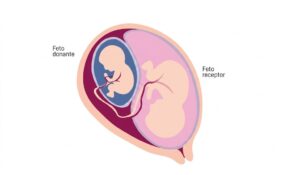
In cases of TTTS there is an unequal exchange of blood between the two twins through the vascular communications of the placenta.
The fetus that gives more blood is called the donor, and the one that receives it is called the recipient.
- The donor experiences a significant loss of blood volume. This causes their body to try to adapt and retain as much fluid as possible to avoid further loss, resulting in decreased urination. For this reason, we see a very small bladder, or none at all, and the amniotic sac remains empty (oligohydramnios).
- The recipient experiences the opposite problem: they receive too much blood, forcing their heart to work beyond its normal capacity, which can eventually lead to heart failure. Therefore, they urinate frequently to eliminate some of the excess fluid. This is why the recipient’s bladder appears very distended and contains much more fluid than would be normal in their amniotic sac (polyhydramnios).