
If you are expecting identical twins who share one placenta (monochorionic twins), I will closely monitor your pregnancy for signs of Twin-to-Twin Transfusion Syndrome (TTTS), a condition that can develop quickly and unexpectedly. Because TTTS may progress within a short period, I recommend ultrasound examinations every two weeks to detect any early changes and provide treatment at the right time. Regular monitoring allows me to identify problems before they become severe and gives your babies the best chance for a healthy outcome.
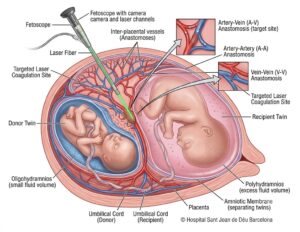 During each ultrasound, I carefully look for the hallmark signs of TTTS. In the donor twin, I check whether there is too little amniotic fluid (oligohydramnios) and whether the bladder is very small or difficult to see, which suggests that the baby is producing very little urine. In the recipient twin, I look for too much amniotic fluid (polyhydramnios) and an enlarged bladder, which indicates increased urine production due to receiving too much blood flow. By carefully evaluating these findings at every visit, I can determine whether TTTS is developing, assess its severity, and discuss the most appropriate treatment options with you as early as possible.