
A congenital pulmonary airway malformation (CPAM) is a mass of abnormal fetal lung tissue that forms during pregnancy. This mass, or lesion, is usually located in one lung and it does not function as normal lung tissue.
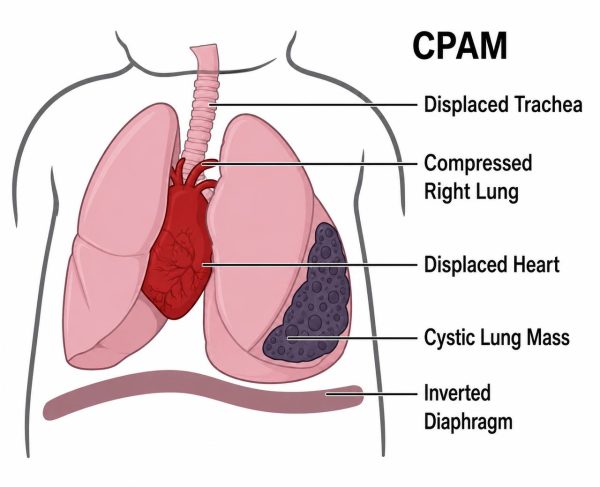
Lesions vary in size and appearance and can change significantly during the pregnancy. A baby with CPAM can have one lesion or many. These lesions can be solid or filled with fluid.
There is no known cause for CPAM, which was previously referred to as congenital cystic adenomatoid malformation (CCAM). The condition is relatively rare, affecting about 1 in 25,000 pregnancies. It is slightly more common in males than in females. CPAM is not hereditary, so it usually does not recur in families.