
Vein of Galen Malformation
Vein of Galen malformations (VOGMs) are rare blood vessel malformations in the brain. The malformation develops before birth and may be found during pregnancy or very soon after birth. This condition affects a large vein deep at the base of the brain. The malformation causes oxygen-rich blood to flow directly through this vein away from the brain instead of delivering blood to surrounding brain tissues. This rush of blood away from the brain puts pressure on the heart and lungs, often causing congestive heart failure or pulmonary hypertension.
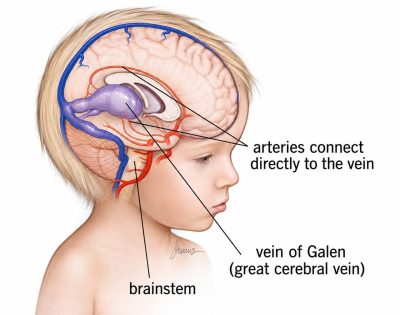
What is a Vein of Galen Malformation?
A vein of Galen malformation starts during early prenatal development, as early as the first trimester. In normal prenatal development, a large vein forms at the base of the brain and is eventually replaced by a true vein of Galen. When a child has a vein of Galen malformation, high-pressure, oxygen rich blood from the arteries flows directly into the initial vein, preventing development of the actual vein of Galen.
Without the vein of Galen, oxygen-rich blood is unable to flow slowly through capillaries that deliver this blood to surrounding tissues. Since there is also no slowing of the blood flow, it rushes quickly away through the vein, causing a constant rush of blood to the heart and lungs. The heart and lungs have to work extra hard to keep up with the volume of blood, which may result in congestive heart failure or pulmonary hypertension. These conditions are often life-threatening.
What Causes Vein of Galen Malformations?
Vein of Galen malformations are not inherited. There is currently no known cause of these malformations, but children with VOGMs are more likely to suffer from other types of arteriovenous malformations (AVMs), or blood vessel malformations
How Common are Vein of Galen Malformations?
These malformations are extremely rare, making them difficult to diagnose right away. VOGMs account for approximately one in three cases of all arteriovenous malformations (AVMs) in children.
VOGMs are slightly more common in males than in females.